What a D2 Head Coach Looks For in a Track and Field Recruit: Insight from Coach Taylor Cudequest at PennWest Edinboro
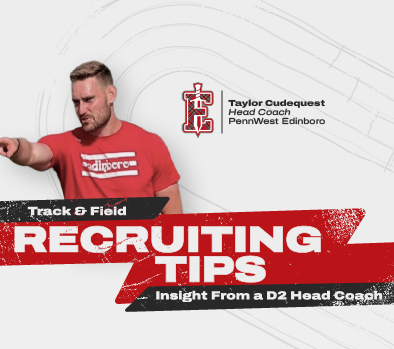
PennWest Edinboro head coach Taylor Cudequest evaluates recruits in public. Here is what his verdicts reveal about how D2 coaches decide who to recruit, and what it means for your profile.

Quick answers
- PRs get you onto a recruiting list. Habits, attitude, and coachability decide whether you stay on it.
- Coaches consider trajectory. A gap between your 60m and your 200m can read as potential rather than a red flag.
- Relay splits carry almost no weight in recruiting. Coaches evaluate fully automatic timed open marks because those compare fairly across every athlete.
- Your GPA is a recruiting stat. It opens scholarship money, clears eligibility, and tells a coach you are dependable.
I follow a lot of college coaches on Instagram. Coach Taylor Cudequest is a unique follow.
He is the head track and field coach at PennWest Edinboro (AKA Edinboro University) and he spends a good portion of his feed explaining, in public, how he decides whether to recruit somebody. He posts example athlete profiles with PRs and grades before giving his verdict. He calls out the things athletes do that quietly cost them offers. He tells parents what he notices when they sit in his office.
That kind of transparency is rare, and it is worth more to a high school athlete than most recruiting content you'll find online today. Below is what his content tells us about how a D2 coach evaluates recruits, organized by what you can do with it.
We featured Coach Cudequest last year as Edinboro started climbing: Coach Cudequest Leads Edinboro Track and Field's Division II Rise. Since taking over in 2024, his program has broken a pile of school records, crowned multiple PSAC champions, and produced NCAA All-Americans. He was a decathlete at Cal State Northridge and a USA U20 medalist before he started coaching.
Your PRs get you on the list. Your habits keep you there.
This is the through line in almost everything Coach Cudequest posts. Performance opens the door. Everything after that is about whether a coach wants to spend four years with you.
He lays out what he watches while evaluating a recruit:
"How you warm up. How you respond after a bad rep. How you communicate with teammates. How you compete when things aren't going your way. Whether you're coachable. How you treat people when nobody is watching."
Then the line that should stick with any recruit reading this:
"Your marks might get you on a recruiting list, but your habits, attitude, and character can determine whether you stay on it."
In a separate post he described knowing an athlete was different before they ever competed for him. They showed up early. They came prepared. They listened, asked questions, and took coaching. His summary: talent gets noticed, attitude gets recruited.
He has also been direct about how much weight character carries, calling it the most important factor in whether an athlete gets recruited. He watches how you conduct yourself and how you respond when a race or a conversation does not go your way. An athlete who says "great race" after losing one, or who is a good teammate on a day when nothing is working, is telling him something useful. None of that shows up on a results page, and all of it is visible at a meet.
What to do with this: assume you are being watched during warm-ups, between attempts, and after a bad race. Coaches attend meets to see athletes compete, and the parts of a meet that are not the race tell them things the results don't. When you meet with a college coach, attend a campus visit, or post on social media, know that how you carry yourself matters.
For more on how coaches turn results into a recruiting board, see How Data and Results Drive Track and Field Recruiting.
"Would I recruit this athlete?"
A highly informative part of Coach Cudequest's content is that he publishes his decision-making process. He shares an example profile with numbers attached and provides his answer with reasoning. Three of these posts are worth walking through, because together they highlight that performance data is the beginning of the evaluation rather than the end of it.
View this post on Instagram
The high jumper with bad mechanics
The example athlete is 6'7" with a 6'9" personal best, and by Coach Cudequest's own description, has an extremely awkward approach. His verdict was yes, without hesitation. Clearing 6'9" consistently proves something he says he cannot teach, which is knowing how to compete and get over the bar. Mechanics are fixable. His framing:
"Results get my attention. Potential gets me interested. Coachability gets you recruited."
View this post on Instagram
The sprinter whose times don't line up
What if a sprint recruit has an outstanding 60m, but 100m and 200m times that aren't as fast as you'd expect them to be? Cudequest noted that a lot of coaches would pass. He would recruit her, because an elite 60m tells him the speed is already there and the rest is a coaching problem. His line was that he is not recruiting a spreadsheet.
This one matters if your event group has an obvious hole in it. A mismatch across your distances is information, and depending on which end is strong, it can point toward upside rather than a limitation.
View this post on Instagram
The two-time transfer
This profile had everything on paper: top five in the conference, a big personal best improvement, a 3.6 GPA, and two-time all-conference. But, the example athlete only had two years of eligibility remaining, a strong social media presence, and two previous transfers.
He called it the kind of transfer that makes coaches earn their paycheck and asked whether the athlete could fit the culture. He left the question open, but it's clear that he sees limited eligibility, a pattern of leaving, and a heavy public profile stack up into meaningful risk even when the talent is obvious.
What these three have in common
Cudequest evaluates trajectory and fit, not just the PR. Two athletes with identical personal bests can be worth very different things to a program depending on how they got there and where they are heading.
If you want help reading where your personal bests place you against a specific program, The Conference-Impact Lens walks through it, and our recruitment standards guide covers the benchmarks by division.
Your relay split is not getting you recruited
I see this one all the time. Athletes submit relay splits to their Streamline Athletes profile and question why their times get invalidated. My answer is that coaches do not make recruiting decisions, or even initial athletic evaluations, based on relay split data.
View this post on Instagram
Coaches discount relay splits because splits are not standardized. Coach Cudequest lists four reasons:
| Why splits don't count | What it does to the time |
|---|---|
| Rolling start | You are already moving when the clock starts on you |
| Handoff position | Where you received the baton changes the distance covered |
| Timing accuracy | Split timing is far less precise than an open race |
| Field strength | Who you were chasing affects how hard you ran |
What coaches use instead is fully automatic timed open marks, because those compare cleanly against every other recruit in the country. His conclusion:
"Relay splits can support your story. Open times get you recruited."
What to do with this: if your best time this season came off a relay leg, it is worth including as context, but it will not carry your recruiting profile. Get open marks in the 100m, 200m, 400m, or 800m on the board.
What a coach needs in front of them
Coach Cudequest's most-pinned post is a complaint, and it is the most practical thing on his page. Athletes message him without marks attached and without a link to a MileSplit or Athletic.net profile, which leaves him doing detective work before he can even decide whether you are worth a conversation.
The five things Coach Cudequest asks for:
- Your name
- What school you go to and who you are
- What interests you about the program
- Your personal bests
- Your intended major
Look at that list: name, school, why this program, marks, major. He is describing a recruiting profile. What frustrates him is that the information usually arrives in pieces, or not at all.
This is one of the problems we built Streamline Athletes to solve. PennWest Edinboro is one of the programs recruiting on the platform. Their staff sees complete athlete profiles, and they reach out to athletes who fit what they are recruiting. That outreach lands in the athlete's Opportunities dashboard.
The athlete decides what happens next. Hit Yes, and the program receives your name, your contact information, and a direct introduction. Athletes with a complete profile who meet a program's criteria will hear from coaches within 24 hours.
The work is the same either way. Coach Cudequest needs your marks, your academics, and a reason you are interested in Edinboro. A complete profile puts all of it in front of him at once, and it does the same for every other program recruiting your event.
Two more things that cost recruits offers
Bringing up money too early
Coach Cudequest has said plainly that opening a first call with scholarship questions sets the wrong tone, because it tells a coach that money is the only thing you are evaluating. What he wants instead is evidence you researched the program, and questions that prove it.
He attaches a second condition that most athletes miss: do not ask about scholarship money if your grades are not where they need to be. The academics come first, and a coach working out what they can offer you is looking at your transcript while they do it.
Matt Morris, head track and field coach at Colorado State University Pueblo, described the same problem when we asked him about it. Scholarship budgets are limited, so coaches need to know a recruit before they can put exact numbers on the table. We covered the timing question in full in When to Ask College Coaches About Scholarships, including what to share about your family’s budget and when.
Worth knowing what to ask instead: our guide to what to ask college coaches covers the questions that move a recruiting conversation forward. And before any of those conversations happen, you need a list of programs to engage with. How to Build a Target List and Email Coaches for Track & Field Recruitment covers how to decide which programs belong on your list.
Going quiet
Coach Cudequest described athletes who engage, express interest, and then disappear. His response is worth quoting because most athletes assume the opposite:
"If you aren't [interested], LET US KNOW! It does not hurt our feelings, it makes our lives easier because we can move on to the next person."
Withdrawing politely costs you nothing and leaves the door open. Ghosting a coach closes it. He has also pointed out that coaches disengage from athletes who are obviously shopping every option without ever narrowing down. If you need a structure for staying in touch, see How to Follow Up With College Coaches and Keep the Conversation Going.
On a visit, the small things break ties
He shared a story about a recruit who wore another school's shirt on an official visit. It cost them the opportunity.
That sounds harsh until you consider what a visit is. A coach is deciding whether to invest years of coaching and a portion of a limited budget in you. Every signal counts, including the ones you did not think were signals.
His guidance for visits:
- Wear neutral clothing or the host school's colors
- Be present and engaged rather than along for the ride
- Send a handwritten thank-you note afterward, or a specific email within 24 to 48 hours
On the thank-you note, he was clear that it will not earn a scholarship on its own. It breaks ties. When a coach is choosing between athletes with similar marks, the impression you left does the deciding.
He has also described what happens in his office when a recruit and their parents sit down, and it covers more ground than most families expect: culture, academics, expectations, development, family, and whether the program is genuinely the right place. Sometimes an offer comes out of it. Sometimes the honest answer is that it is not a fit, which he treats as a good outcome rather than a failure.
For how visits differ across associations, see Official and Unofficial Recruiting Visits.
Parents: let your athlete answer
This one is short and worth reading twice.
"If a coach asks your athlete a question and a parent answers first, it's a missed opportunity for the athlete to make an impression."
Coaches are evaluating maturity, communication, and confidence alongside athletic ability, because they are deciding whether this person can represent their program for four years. Every question a parent fields is a data point the coach does not get.
His framing: parents guide, athletes lead. More on where parents add the most value in College Track & Field Recruiting for Parents: Answers to the Questions Families Ask Us Most.
GPA and social media are both recruiting stats
Your transcript
Coach Cudequest calls the belief that coaches only care about athletic performance one of the biggest recruiting myths, and he has watched talented athletes lose opportunities over grades. A strong GPA opens scholarship money, clears academic eligibility, and gives a coach confidence you will still be enrolled in year three. We covered how coaches read academic fit in How College Track Coaches Evaluate Academic Fit.
Your social media profiles
Coaches check social media before making an offer. His advice avoids the usual scolding, and the standard he sets is useful: your profile should show work ethic, character, and investment in your sport, and it should contain nothing that raises a question a coach has to ask about. Follower count is irrelevant. Notice too that a strong social media presence appeared on the transfer profile above as a neutral-to-negative factor, which is a reminder that visibility cuts both ways depending on context.
FAQ
What do D2 track and field coaches look for in recruits?
Marks that fit the program's scoring range, then trajectory, coachability, character, and academic reliability. Coach Taylor Cudequest of PennWest Edinboro describes marks as what gets an athlete onto a recruiting list, with habits and attitude determining whether they stay on it.
Do college coaches care about relay splits?
Not much. Relay splits are not standardized, because rolling starts, handoff position, timing accuracy, and the strength of the field all affect the time. Coaches evaluate fully automatic timed open results so they can compare recruits fairly and accurately.
Does GPA matter for track and field recruiting?
Yes. GPA affects academic eligibility, opens access to scholarship money, and signals dependability to a coach. Coaches have passed on athletes with strong marks over academic concerns.
Do college coaches look at your social media?
Yes. Coaches commonly check an athlete's profiles before extending an offer. They are looking for work ethic and character, and for anything that raises a concern.
What should I include in my first message to a college coach?
Coaches need to know your name, your school, what interests you about that specific program, your personal bests, and your intended major. If you're communicating with coaches via Streamline Athletes, whether the coach contacted you or you hit the "Contact Coach" button, your complete Streamline Athletes profile carries most of this information, so your first email to the coach can look a little different. We commonly recommend specifying why you're interested in the program and/or school, sharing your availability for a call, and always confirming the next steps in the process.
What should I wear on an official visit?
Coach Cudequest at PennWest Edinboro recommends neutral clothing or the host school's colors. Wearing another school's gear on a visit sends the wrong message and has cost recruits opportunities. Streamline Athletes recommends smart casual or athletic gear, as long as it's not apparel you collected from another visit.
How do coaches evaluate transfers?
Talent and results matter, and so does the pattern behind them. Remaining eligibility, the number of previous transfers, and the reasons for leaving all factor in. A strong résumé with multiple transfers attached reads as risk, because the coach is betting on a cultural fit that has not held elsewhere.
Follow Coach Cudequest
He posts recruiting content regularly at @cudequesttaylor. If you are being recruited or about to be, it is one of the better free resources available, and it comes from someone currently making these decisions.
Be recruited by Coach Cudequest and PennWest Edinboro
- Create your free Streamline Athletes account.
- Complete your profile to 100%.
- Receive a request from the coaching staff at PennWest Edinboro and any other programs for which you are an athletic, academic, and geographic fit on paper within 24 hours.