
How College Track Coaches Evaluate Academic Fit (and How to Show Yours)
Coaches evaluate your grades as a recruiting signal. Here is how academic fit works across the NCAA, NAIA, and U SPORTS, and how to show yours.

TL;DR: College track and field coaches identify recruits through performances first, then check grades immediately after, because your academics decide whether an opportunity exists at all. Grades tell a coach two things: whether you can get admitted without risk, and how much of your education can be funded without spending athletic scholarship budget. In an equivalency sport like track and field, academic money often exceeds athletic money. Show your fit by putting your GPA, transcript, and intended field of study on your recruiting profile next to your verified performances, so a coach can evaluate the full picture in one place.
Academic fit is one part of getting recruited. To see how it fits with everything else coaches weigh, from your PRs to your grades to where you want to live, start with our complete guide to getting recruited for college track and field.
Why do college track coaches care about your academics?
A coach evaluating a recruit is managing risks. The first risk is athletic: will this athlete develop and score points? The second is administrative: will this athlete clear admissions, stay eligible, and fit within a limited scholarship budget? Strong PRs answer the first question. Your grades (or academic marks) answer the second, and coaches will not spend a recruiting cycle on an athlete who might not get into their university.
Track and field is an equivalency sport in NCAA D1, D2, and the NAIA, which means coaches can divide scholarship money across the roster however they choose. Full rides exist, but most offers are partial, and every recruit is a funding decision. An athlete whose grades unlock academic merit aid costs less athletic budget, which makes that athlete easier to recruit. This is why coaches ask about your GPA in the first conversation. It is not small talk.
At Southern Maine, Coach Rob Whitten checks a recruit's grades before their performances. Here is how Southern Maine evaluates recruits.
Coaches identify recruits through performances first: results, rankings, PRs. Grades come immediately after, because the answer determines whether an opportunity exists at all. From there, the conversation is budget fit and intangibles. A recruit whose grades are a question mark is a gamble, and coaches recruit more athletes than they sign. When two recruits are at a similar performance level, the stronger student usually gets the roster spot.
Coaches say it plainly too. PennWest Edinboro head coach Taylor Cudequest calls the belief that coaches only care about athletic performance one of the biggest recruiting myths, and he has watched talented athletes lose opportunities over grades. More on how he evaluates recruits in What a D2 Head Coach Looks For in a Track and Field Recruit.
How do college coaches evaluate academic fit?
Coaches are not comparing you against NCAA minimums. They are comparing you against their school's admission profile. The NCAA's core-course GPA floors of 2.3 for D1 and 2.2 for D2 keep you eligible, but most programs admit well above those numbers, and competitive recruits tend to sit in the 2.8 to 3.5+ range. Some coaches hold a hard 3.0 cutoff regardless of how strong the athlete is, so a low GPA can end a conversation your performances started. The full breakdown of eligibility standards, registration steps, and approved core courses lives in our guide to the NCAA and NAIA eligibility centers.
Beyond the GPA number, coaches look at three things.
- Course rigor
A 3.4 built on university-preparation courses reads differently than a 3.4 built on the easiest available schedule. Coaches at academically selective programs know the difference because their admissions offices do. - Major fit
If you plan to study engineering, nursing, business, or certain other fields, admission often runs through the faculty or program, not just the university. Those programs carry their own prerequisites. A coach cannot recruit you into a major you cannot get into. At Concordia University of Edmonton, it is the first thing the head coach checks. Read how Concordia evaluates recruits. - Trajectory
An upward grade trend through grade 11 and 12 reads as maturity. Coaches sign people for four or five years. Evidence that you handle increasing academic load while training and competing is part of your case.
Strong academics can move borderline athletic cases. A coach with one roster spot and two athletes at similar performance levels will take the one who clears admissions cleanly and brings merit aid to the table. Your grades can win you a spot your PRs alone would not.
How do you show academic fit on your recruiting profile?
Coaches act on complete information. A Streamline Athletes profile that shows your verified track and field performances next to your academics lets a coach evaluate athletic and academic fit in one review instead of chasing you for documents weeks later.
Here are three steps to take when completing or updating the Academic Information section of your Streamline Athletes profile:
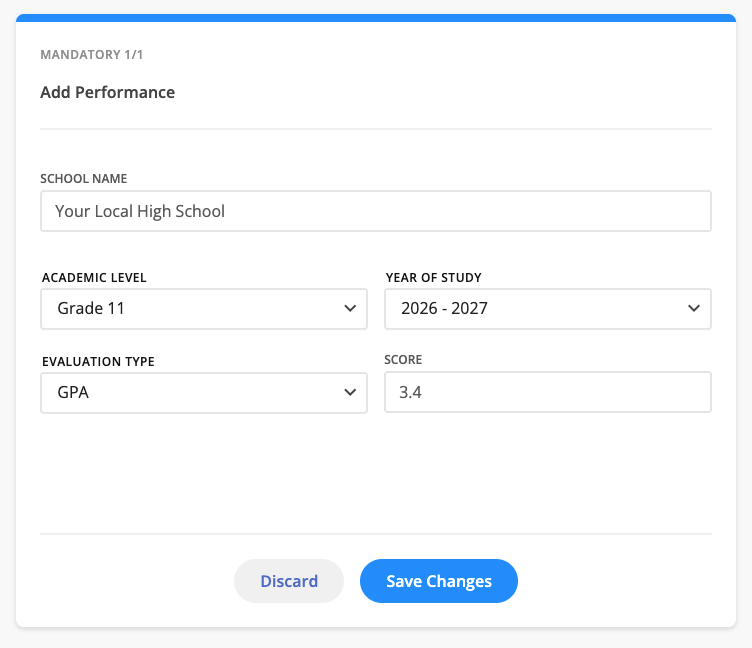
Step 1 - Add your GPA or average
Enter your GPA or percentage average in the Academic Information section of your profile. This is the single number coaches filter on first.
Step 2 - Upload your transcript or report card
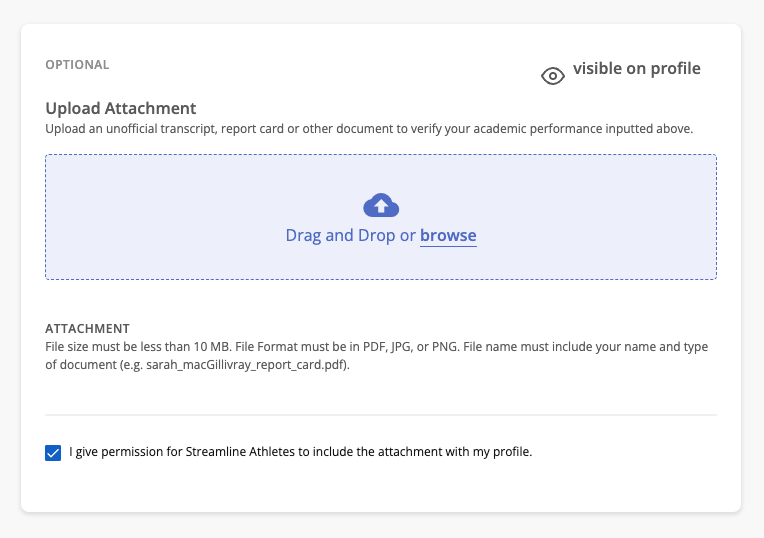
A recent transcript or report card backs the number and shows course rigor. Documents you upload stay private and are shared only with coaches you choose to correspond with. Coaches trust documents over self-reported figures, and a documented GPA lets a coach evaluate your academic fit in the same pass as your performances. Add or edit a previously entered academic year ("performance"), then scroll down to the Upload Attachment card to attach supporting documentation.
Step 3 - Add your desired field of study
Your intended major shapes which schools and faculties are a match, and it tells a coach whether their institution can offer what you want. If you are undecided, say so; that is still useful information. When editing your Streamline Athletes profile, scroll down to the bottom of the Academic Information section to find the "Desired Field of Study" section. Add more than one academic area if multiple fields apply.
One rule sits above all three steps: report your grades accurately. Coaches use your self-reported GPA to decide whether an opportunity could exist before they invest time and energy into recruiting you. An inflated number will be exposed the moment you share your transcript. Padding the number wastes everyone's time, yours included.
Academics + Verified Performances
Put your grades and performances in one place coaches can act on.
Create your free profileHow do international grades convert to a US GPA?
If you were educated outside the United States, your grades do not need to arrive pre-converted. Report them accurately in the scale your school uses and upload the documents behind them. Canadian athletes can enter their percentage average on their Streamline Athletes profile as is; coaches recruiting across the border work with percentages all the time, and the Eligibility Center handles the official conversion. Where a rough conversion earns its keep is targeting. If a US program you want holds a cutoff on the 4.0 scale, knowing approximately where your average lands tells you whether that school deserves your recruiting time or whether it belongs on a longer-shot tier of your target list.
Two warnings before the numbers:
- First, these are approximate equivalencies for planning. Grading scales vary by school, district, province, and exam board, and no single conversion chart is official.
- Second, the NCAA Eligibility Center runs its own country-specific conversions, published in the NCAA Guide to International Academic Standards for Athletics Eligibility. Its core-course GPA is calculated unweighted from approved core courses only. Your transcript GPA and your NCAA GPA are two different numbers, and the Eligibility Center's is the one that decides eligibility.
US Letter Grade, Percentage, and 4.0 GPA Scale
| Letter grade | Percentage | 4.0 GPA |
|---|---|---|
| A+ / A | 93–100 | 4.0 |
| A− | 90–92 | 3.7 |
| B+ | 87–89 | 3.3 |
| B | 83–86 | 3.0 |
| B− | 80–82 | 2.7 |
| C+ | 77–79 | 2.3 |
| C | 73–76 | 2.0 |
| C− | 70–72 | 1.7 |
| D+ | 67–69 | 1.3 |
| D | 65–66 | 1.0 |
| F | Below 65 | 0.0 |
The most widely used US high school scale. Individual schools vary; some use 90–100 as the full A band with no plus/minus grades.
International Systems: Approximate US Equivalents
| System | ≈ A (4.0) | ≈ B (3.0) | ≈ C (2.0) |
|---|---|---|---|
| Canada — BC (percentage) | 86–100 | 73–85 | 60–66 |
| Canada — Ontario (percentage) | 80–100 | 70–79 | 60–69 |
| UK A-levels | A* / A | B–C | D–E |
| UK GCSE (9–1) | 9–7 | 6–5 | 4 |
| IB subject grades (1–7) | 7–6 | 5 | 4 |
| France (out of 20) | 14–20 | 12–13 | 10–11 |
| Germany (1–6) | 1 | 2–3 | 4 |
| WASSCE (West Africa) | A1–B2 | B3–C4 | C5–C6 |
| South Africa NSC (levels 1–7) | 7 | 6 | 5–4 |
Approximate equivalencies for planning only. Canadian letter-grade bands are set by each province; BC and Ontario are shown as the two most common references. The NCAA Eligibility Center applies its own country-specific conversions; see the NCAA Guide to International Academic Standards for Athletics Eligibility.
How does academic money work across divisions and associations?
Athletic scholarships get the attention, but in track and field, academic money frequently does more of the work. How the two interact depends on where you compete.
Where Academics Fit Into the Money
| Association | Athletic aid | Where academics fit |
|---|---|---|
| NCAA D1 | Equivalency sport; partial to full scholarships at the coach's discretion | Merit aid stacks with athletic aid; strong grades stretch a coach's budget |
| NCAA D2 | Equivalency sport; awards split across the roster, full rides possible | Academic aid often carries a larger share of the package than athletic aid |
| NCAA D3 | None | Academic merit and need-based aid are the entire financial package |
| NAIA | Flexible athletic scholarships | Athletic aid stacks with institutional and academic aid with fewer restrictions |
| U SPORTS | Athletic financial awards capped at tuition and fees | Entrance scholarships based on admission average are often automatic and can exceed athletic awards |
In NCAA D1 and D2, partial athletic aid combined with academic merit scholarships is a normal recruit package, and full rides go to the athletes a coach prioritizes most. Nearly all D1 programs have opted into the House settlement structure, which replaced sport-by-sport scholarship caps with roster limits and changed how coaches budget their classes. We cover those changes in detail in our breakdown of the NCAA roster and scholarship changes. The practical takeaway does not change: an athlete who brings academic money to the table is easier to fund.
In NCAA D3 there is no athletic aid at all, so your grades are your scholarship. D3 programs recruit hard, and the money conversation is a conversation about your transcript.
In the NAIA, athletic scholarships can stack with institutional and academic aid with fewer restrictions, so a strong student often assembles a larger total package at an NAIA school than a comparable partial offer elsewhere.
In U SPORTS, athletic financial awards are capped at tuition and compulsory fees, and the money story is grades-first in a different way. U SPORTS removed its national rule requiring an 80% entering average to receive an athletic financial award, effective 2024-25, though individual conferences and schools can still apply stricter award criteria, so confirm the rules at each school on your list. Separately, many Canadian universities award entrance scholarships automatically based on your admission average. For a strong student, that automatic academic money can rival or exceed anything athletic on the table.
"There are far more academic scholarship dollars available than athletic — so grades, grades, grades."

Head Coach, Track & Field / Cross Country · University of Saskatchewan
How do coaches use ACT and SAT test scores when they evaluate you?
The NCAA stopped requiring test scores for Division I and Division II eligibility in 2023. Scores still matter at some schools, and not for eligibility reasons. At most programs nobody will ask. At academically selective ones, your score can decide whether a coach keeps recruiting you.
Coaches do not make admissions decisions. At a school where admissions is competitive independent of athletics, a coach has a limited number of slots to spend and cannot afford to waste one on a recruit who gets rejected. Highly selective private universities and academically demanding Division III programs are the clearest examples. You will know you are talking to one of them because the coach asks about your score early, or at least checks that you are registered for a test.
Even at those schools, most programs publish guidelines rather than hard cutoffs. Coaches weigh academic commitment alongside growth potential, character and work ethic. A score a little below a published guideline does not usually end the conversation. A score well below it does.
Scores also affect academic scholarship money, and that matters more in track and field and cross country than in most sports. Athletic aid gets split across a large roster, so academic awards often make up a bigger share of an offer than athletic money does. Raising a test score can be worth more to your final cost than shaving a tenth off a personal best.
Ask early. Coaches will tell you what their program needs academically if you ask them directly. If you are deciding between the two tests, our guide to the SAT and ACT covers the differences. If you are in Canada, check where you can take the ACT before booking a date, because there are only eight test centres in the country.
What should you say to a coach about your academics?
When you express interest in a program, mention your GPA or average and your intended field of study alongside your primary events and PRs. That is the information a coach needs to run your name past admissions and to start thinking about a funding package.
If your grades are a weakness, address it rather than hiding it. An honest note about an upward trend, a course correction, or a plan to retake a class reads far better than a surprise on the transcript later. Coaches have seen every version of this and they value recruits who manage it directly.
For the full playbook on building your school list and starting coach conversations the right way, start with our guide to building a target list.
FAQ
What GPA do college track coaches want to see?
There is no universal number, but competitive NCAA recruits usually fall in the 2.8 to 3.5+ range, well above the NCAA's eligibility floors of 2.3 for D1 and 2.2 for D2. Some coaches hold a 3.0 minimum regardless of performance level. Coaches evaluate your GPA against their school's admission profile, and higher grades unlock academic merit aid that makes you easier to fund.
Can strong academics make up for weaker performances in recruiting?
Often, yes, at the margins. Coaches choosing between athletes at similar performance levels usually take the stronger student because they clear admissions cleanly and bring academic aid that preserves athletic budget. Grades will not replace performance standards, but they regularly decide borderline cases.
How do recruitment platforms combine academic and athletic profiles?
Streamline Athletes puts verified performances and academic information in one profile. Athletes add their GPA or average, upload a transcript, and list their intended field of study alongside athletic performances verified against official meet results. Coaches evaluate athletic and academic fit in a single review, which is what turns interest into contact.
How do NCAA D3 track athletes get scholarship money?
D3 programs do not offer athletic scholarships. Financial packages come from academic merit aid and need-based institutional aid, which means your transcript is the primary driver of your offer. Many D3 schools award substantial merit money to strong students.
What is an admissions pre-read in track recruiting?
A pre-read is an early review of a recruit's transcript by a school's admissions office, requested by the coach, to gauge whether the athlete would be admitted. Formal pre-reads are most common at academically selective programs and uncommon elsewhere. The universal version is informal: coaches identify recruits by performance, then check grades immediately to confirm an opportunity exists, which is why an accurate GPA on your profile matters from first contact.
Do Canadian universities consider grades in track and field recruiting?
Yes. U SPORTS removed its national 80% entering-average requirement for athletic financial awards starting in 2024-25, but conferences and schools can apply stricter criteria, admission in Canada is faculty-based, and many universities award entrance scholarships automatically based on admission average. Strong grades expand both admission options and total funding.