Email Template for Contacting College Track and Field Coaches
A first email to a college track and field coach should tell them in under a minute whether you could fit. Here's what it looks like when you send it from your Streamline Athletes account.

A first email to a college coach has one job: give them what they need to decide, in under a minute, whether you could fit their program. Here's what that email looks like when you send it from your Streamline Athletes account, and why it's built this way.
Quick answers
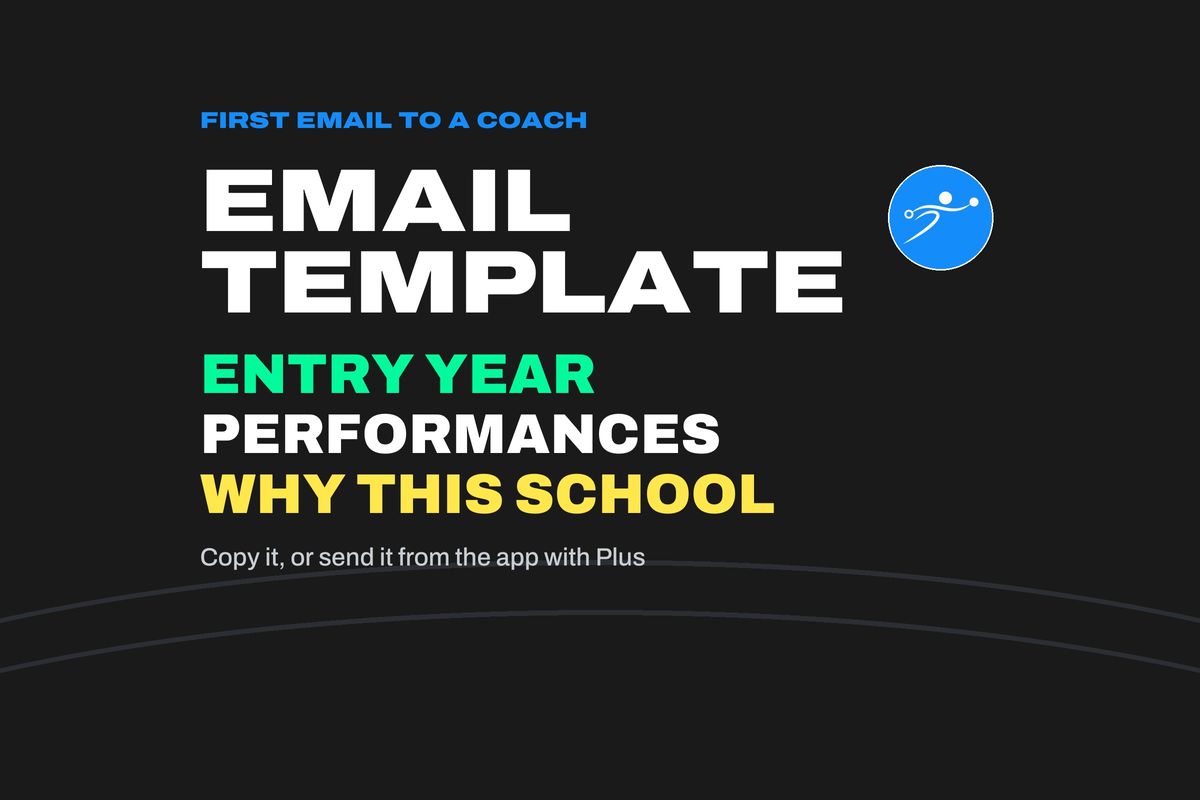
- Subject line: your college entry year, your best event and verified performance, and the school.
- Lead with performances. Most coaches qualify athletes on athletics first, then grades.
- Say why this program. Use the coach's name and give one specific reason only you could write.
- Share a budget range if cost matters, but don't ask for an athletic scholarship in your first email.
- Send it from your profile. Your performances, entry year, academics, and profile go into every email, so you only write the why.
What a first email to a coach looks like
This is what a coach receives when you press Contact Coach on a program in the Streamline Athletes app. Everything except the why and your note comes straight from your profile.
| From | Jordan Smith via Streamline Athletes |
|---|---|
| Subject | 2027 Entry · 800m (1:54.20) interested in [School] |
| Coach [Last name], I'm interested in [School] because [your reason: your event group, a recent conference result, your major, something you learned about the team]. My best performances: 800m 1:54.20 · 400m 49.10 About me: 2027 college entry, 3.8 GPA, from Ohio. [Your note, for example: My next meets are [meet, date] and [meet, date]. Cost will be a big part of my decision, so I'd like to find an opportunity where an out-of-pocket budget of $XX,XXX to $XX,XXX a year could be realistic. I've also filled out your recruiting questionnaire.] Thank you, Jordan Smith Jordan Smith · Class of 2027 Full profile: verified performances and academics [Interested] [Not a fit] |
The coach answers with one click. Interested starts an email thread between you and the coach and shares your contact details. Two polite follow-ups go in your name if the coach hasn't answered, and they stop the moment the coach responds. The template is built from thousands of athlete-to-coach emails sent since 2017, and we've tested and tweaked it based on how coaches respond. See how it works in can athletes contact college coaches from the Streamline Athletes app?
How to start sending
- Create your free profile. Add your events, academics, and entry year. We verify your performances with official meet results. Create your free profile.
- Upgrade to Plus to email programs yourself. Save programs to your Wishlist, and press Contact Coach where your performances fit. The app checks each program's standards and finds the coach who recruits your events. See Plus.
The 6 Ps of a coach email
Coaches want communication that is professional, polite, personal, punctual, precise, and passionate. Here's what each one means in practice.
- Professional: a clear subject line, a proper greeting, and no slang.
- Polite: thank them for their time, and don't demand a reply.
- Personal: use the coach's name and give a real reason you're interested in their program.
- Punctual: reply quickly when a coach writes back, and send updates when you have a new performance.
- Precise: your entry year, events, and exact verified performances in the first lines, with a link to the results.
- Passionate: show you want to compete and improve there, in a sentence, not a paragraph.
What coaches check first
Most coaches qualify athletes on athletics first. They compare your performances with what their program needs, so lead with them. Our college track and field recruiting standards show the ranges by event and division.
Grades come next. At Ivy League programs and other high academic schools, academics can come first, so put your GPA and test scores up front for those programs. See the academic requirements for college track and field.
Budget comes up early too, often earlier than families expect. If cost will decide where you go, it's fine to share a rough out-of-pocket budget range in your first email without locking yourself into a number. Don't ask for an athletic scholarship in your first email. Read when to ask college coaches about scholarships.
Always include your college entry year. Coaches recruit by entry year, and it's the first thing they need to know where you fit.
Taylor Cudequest, head coach at PennWest Edinboro, lists the five things he wants in a first message: your name, your school and who you are, what interests you about the program, your personal bests, and your intended major. Read more in what a D2 head coach looks for in a track and field recruit.
Writing from your own inbox?
If you'd rather email a coach yourself, here's a plain version to copy. Replace everything in brackets and keep it short.
| Subject | [Entry year] Entry · [Event] ([best verified performance]) interested in [School] |
|---|---|
| Coach [Last name], My name is [Your name], and I'm a [year of high school] at [High school] in [City, State or Province]. I plan to start college in fall [entry year]. I'm interested in [School] because [one specific reason]. My best performances: [event] [performance] · [event] [performance]. My verified results are here: [link]. I plan to study [major], and I have a [GPA] GPA. [If cost matters: Cost will be a big part of my decision, so I'd like to find an opportunity where an out-of-pocket budget of $XX,XXX to $XX,XXX a year could be realistic.] My next meets are [meet, date] and [meet, date]. Thank you, [Your name] [Phone] | [Email] |
Many programs post a recruiting questionnaire on their athletics website. For programs where you're a realistic fit, fill it out and mention it in your email. See how to contact coaches in the recruiting guide.
Why common templates often don't work for track and field
Most templates you'll find online were written for every sport at once. Three things tend to go wrong for track and field athletes:
- They're built around video. Many ask a coach for feedback on a highlight reel. Track and field coaches recruit on verified performances, so lead with those and a link to official results.
- They make the coach go looking. A line like "click the link below for all my information" sends the coach to find your performances, academics, and entry year. Put them in the email.
- They're long and generic. A paragraph of "I believe I have what it takes" uses the coach's time without telling them anything. Coaches can tell when an email was pasted to 50 schools. One specific sentence about their program does more.
Most templates also leave out your entry year and budget, two things coaches need to know early.
Frequently asked questions
What should I put in the subject line of an email to a college track coach?
Your college entry year, your best event and verified performance, and the school. For example: 2027 Entry · 800m (1:54.20) interested in [School].
What should a first email to a college track and field coach include?
Why you're interested in that program, your best verified performances, your entry year, GPA, and where you're from, a link to your full profile, and your upcoming meets.
How long should an email to a college coach be?
Short enough to read in under a minute. Five or six short paragraphs is plenty.
Should I fill out a college's recruiting questionnaire too?
Yes, for programs where you're a realistic fit. Fill it out and mention it in your email.
Should I mention money in my first email to a coach?
If cost will decide where you go, share a rough out-of-pocket budget range without locking yourself into a number. Don't ask for an athletic scholarship in your first email.
Send it from your profile
Your profile fills in the facts. You write the why.
Create your free profile